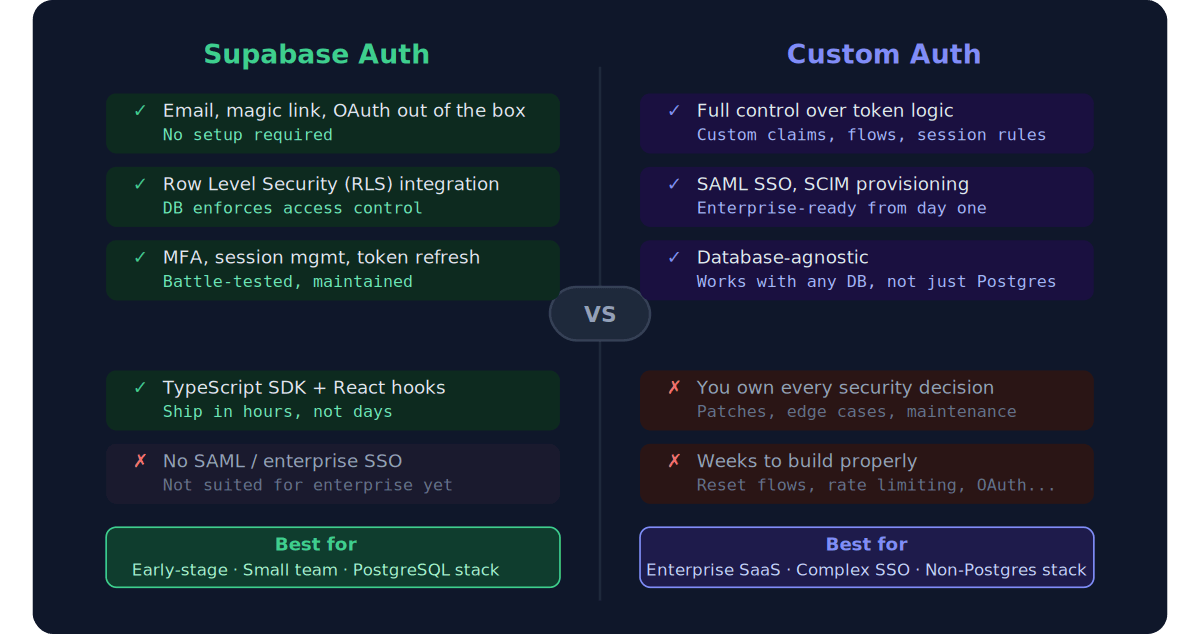
Supabase vs Custom Auth: What I Recommend for Early-Stage SaaS
Every SaaS founder faces the auth question early. Build it yourself or use Supabase? Here's my honest take after building both — and the 3 questions that make the decision easy.

Niklas Grieger
It's 2am. You've just set up your database, your API is taking shape, and now you're staring at the auth problem. Do you roll your own? Do you reach for Supabase? Does it even matter at this stage?
It matters more than you think — and the wrong choice can cost you weeks. I've built both, and this is what I'd tell you over coffee.
What "Custom Auth" Actually Means
When people say "custom auth" they often underestimate the scope. It's not just hashing a password and issuing a JWT. A production-ready custom auth system includes:
- Password hashing with bcrypt or argon2
- JWT issuance and validation
- Refresh token rotation and revocation
- Secure HTTP-only cookie handling
- Email verification flow
- Password reset flow (with expiring tokens, rate limiting)
- OAuth provider integration (Google, GitHub, etc.) if you need social login
- Session invalidation on logout across devices
- Brute force and rate limiting protection
- GDPR-compliant data handling
Each of these is straightforward in isolation. Together, they're a significant surface area to build, test, and — critically — maintain over time.
Security vulnerabilities don't announce themselves. A misconfigured token rotation, a missing rate limiter, an improperly stored refresh token — these are the things that get startups into trouble. And when a security issue surfaces 18 months in, you're the one patching it at 2am.
What Supabase Auth Gives You Out of the Box
Supabase Auth is built on top of GoTrue, a battle-tested auth server. Out of the box you get:
- Email/password authentication
- Magic link (passwordless) login
- OAuth providers: Google, GitHub, Apple, Twitter, Discord, and more
- Phone/SMS auth
- Multi-factor authentication (TOTP)
- Row Level Security (RLS) integration — this is the big one
- Session management across tabs and devices
- JWT issuance with automatic refresh
- Full JavaScript/TypeScript SDK with React hooks
The RLS integration deserves special mention. Because Supabase Auth is deeply integrated with PostgreSQL, you can write database policies like:
create policy "Users can only see their own data"
on public.profiles
for select
using (auth.uid() = user_id);
Your database enforces access control at the row level. Your API doesn't need to manually check ownership on every query. For a small team, this is a genuine superpower.
The Hidden Cost of Custom Auth
The build cost is visible. The maintenance cost is not.
Custom auth means you own every security decision going forward. When a new JWT vulnerability surfaces, you patch it. When OAuth providers update their flows, you update yours. When a user gets locked out because of a token edge case, you debug it.
There's also the compliance angle. GDPR, SOC 2, ISO 27001 — any serious enterprise customer will ask about your auth setup during due diligence. Supabase is a known, auditable system. "We built our own" opens a much longer conversation.
For a solo founder or a small team focused on building product, every hour spent on auth infrastructure is an hour not spent on the features that actually differentiate your SaaS.
When Supabase Auth Is the Right Call
Use Supabase Auth when:
- You're early-stage and need to ship fast
- Your team is small (1–5 engineers)
- You're already using PostgreSQL — the RLS integration alone is worth it
- You need social login without the OAuth implementation overhead
- You want passwordless/magic link login without building it yourself
- You're building a B2C or early B2B product where enterprise SSO isn't required yet
In short: if you're in the "validate the idea" phase, Supabase Auth lets you move on to what actually matters.
When Custom Auth (or a Dedicated Provider) Makes Sense
There are legitimate reasons to go custom or reach for a dedicated provider like Auth0:
Enterprise requirements. If your customers need SAML SSO, SCIM provisioning, or custom session durations — Supabase Auth doesn't cover these yet. Auth0 or a custom implementation is the right call.
You're not using PostgreSQL. Supabase's RLS magic only works because everything is Postgres. If your database is MongoDB, DynamoDB, or something else, you lose the deepest integration benefit.
Highly specific session logic. If you need very custom token claims, unusual session behaviours, or complex multi-tenant auth flows, rolling your own gives you full control.
You're already in the AWS ecosystem. If your infrastructure is deeply AWS-native, Cognito integrates tightly with IAM, API Gateway, and Lambda — making it a natural fit despite its notoriously rough developer experience.
My Personal Recommendation: 3 Questions
Before choosing, ask yourself:
1. Are you validating or scaling? If you're still figuring out whether your SaaS idea works, use Supabase Auth. Don't over-engineer for problems you haven't got yet. You can always migrate later — and migrating auth is far less painful than migrating a CMS (trust me, I've done both).
2. Do your target customers require enterprise SSO? If yes — or if you think they will within 12 months — factor that into your choice now. Supabase doesn't support SAML today. If enterprise is your market, Auth0 or a custom solution is worth the extra setup.
3. Are you using PostgreSQL? If yes, Supabase Auth is a near-automatic choice. The RLS integration is genuinely one of the most underrated features in the modern developer stack. You get database-level access control essentially for free.
For the vast majority of early-stage SaaS products, Supabase Auth is the right answer. It's secure, well-maintained, developer-friendly, and lets you focus on your product instead of your infrastructure.
Save the custom auth build for when you have a specific reason that Supabase genuinely can't meet. That day may come — but it's rarely day one.
Building a SaaS and not sure how to structure your auth and backend? I help early-stage teams make these architectural decisions and implement them. Let's talk.
Storyblok as a WordPress Alternative: One Client Build
A booking site for a family-course studio, built in about two months. What went into Storyblok, what stayed in Postgres, and why the client maintains her own content without calling me.
Vue vs React: What Vapor Mode Actually Changes
I've built every business project on Vue and Nuxt for seven years, and two recent ones in React and Next.js instead. Here's what genuinely felt different for headless CMS frontends, and why Vue just walked away from the virtual DOM entirely.